NRSC Conducts Capacity Building Programme on Forest Fire Detection and Burnt Area
Mapping for Bhutan Officials
Home
/ NRSC Conducts Capacity Building Programme on Forest Fire Detection and Burnt Area
Mapping for Bhutan Officials
June 18, 2026
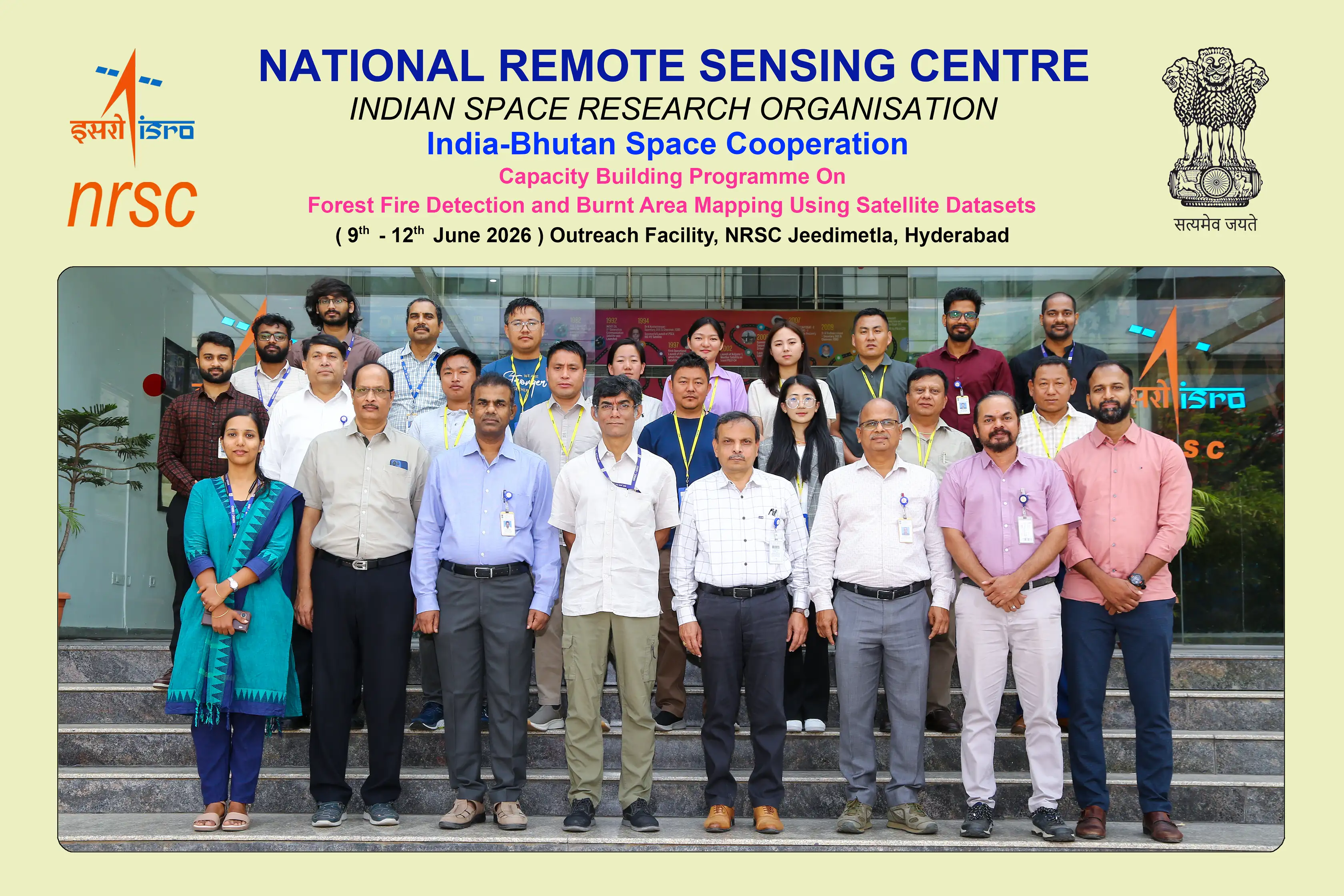
Under the India–Bhutan Space Cooperation Programme, the National Remote Sensing Centre (NRSC), Indian Space Research Organisation (ISRO), successfully conducted Capacity Building Programme on “Forest Fire Detection and Burnt Area Mapping Using Satellite Datasets” from 9–12 June 2026 at its Jeedimetla Campus, Hyderabad,.
The four-day training programme brought together 11 officials from the Royal Government of Bhutan, representing key organizations including the Department of Forests and Park Services (DoFPS), College of Natural Resources (CNR), National Land Commission Secretariat (NLCS), and the GovTech Agency. The programme was organized in response to a request from Bhutan’s GovTech Agency, Division of Telecom and Space, to strengthen national capabilities in the use of space technology for forest fire monitoring, assessment, and management.
The training focused on enhancing technical expertise in satellite-based forest fire detection, burnt area mapping, fire severity assessment, and operational fire management systems. Participants attended a comprehensive series of lectures, hands-on practical sessions, demonstrations, and interactive discussions led by scientists from NRSC’s Forestry and Ecology Group (FEG).
Key topics covered included remote sensing fundamentals, thermal remote sensing, active fire detection using MODIS and VIIRS satellite datasets, burnt area assessment, AI and machine learning applications in forest fire analysis, and operational fire alert generation and dissemination systems.
The programme was further enriched through expert lectures delivered by specialists from ISRO centres, including the Indian Institute of Remote Sensing (IIRS) and Space Applications Centre (SAC), as well as the Forest Survey of India (FSI). These sessions highlighted Fire Danger Rating Systems, the use of geostationary satellites for real-time forest fire monitoring, and India’s operational practices in forest fire management.
As part of the programme, participants visited the NRSC Shadnagar Campus, where they gained first-hand exposure to India’s end-to-end satellite data reception and processing infrastructure. The visit included demonstrations of the Satellite Data Reception Facility, Bhuvan Geoportal Services, and the National Database for Emergency Management (NDEM), showcasing operational systems for forest fire information generation and dissemination.
The programme provided an effective platform for knowledge exchange between Indian and Bhutanese experts and identified new opportunities for strengthening bilateral cooperation in the application of space technology for forest fire monitoring and sustainable forest management under the India–Bhutan Space Cooperation framework.