Unusual Stratospheric Ozone Enhancement Over the North Bay of Bengal: Insights from the Indian ST/MST Radar Network and Balloon-Borne Experiments
Home
/ Unusual Stratospheric Ozone Enhancement Over the North Bay of Bengal: Insights from the Indian ST/MST Radar Network and Balloon-Borne Experiments
August 26, 2026
The stratospheric ozone layer, which peaks at altitudes between 25 and 30 km, regulates the amount of solar ultraviolet radiation reaching the Earth's surface. Stratospheric chemistry alters when trace gases are transported from the troposphere to the lower and middle stratosphere, typically depleting stratospheric ozone. Conversely, mid-latitude intrusions and overshooting convection can cause sporadic ozone increases in the upper troposphere and lower stratosphere. To investigate these dynamics across different geographic regions, scientists from several Indian national laboratories (SPL, NARL, SHAR, CUSAT, IITM, ARIES, & Calcutta University) conducted a joint experimental campaign from 12–18 February 2024. Named NetRAD-ASMA (Network of Stratosphere-Troposphere/Mesosphere-Stratosphere-Troposphere Radars and Balloon-Borne Measurement Campaigns of the Asian Summer Monsoon Anticyclone), the initiative operated a network of ST/MST radars across Gadanki, Cochin, Haringhata, and Nainital. This was complemented by simultaneous radiosonde and ozonesonde launches from all four radar sites, including Trivandrum, Pune, Silkheda, and Kolkata, with a focal point at the Indian subtropical station Balasore.
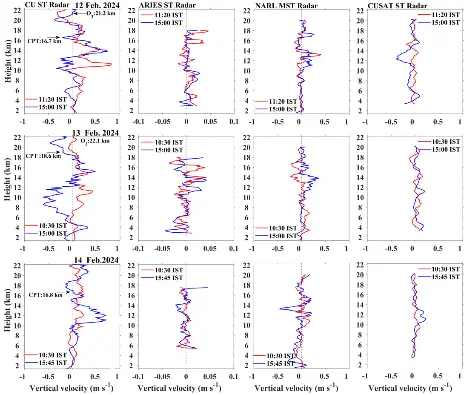
During this campaign led by SPL/ISRO, a novel, unprecedentedly elevated ozone layer by ~ 50 nbar from its climatological mean was observed within the stratosphere, exceeding the typical stratospheric ozone maximum. This unique feature was detected near the head of the Bay of Bengal—a region characterized by deep convection. The anomalous layer spanned a thickness of 2.1 to 2.4 km and persisted for over 24 hours. Data from the ST/MST radar network suggest that the primary drivers of this enhanced stratospheric ozone layer were either air mass compression or the advection and intrusion of mid-latitude air, as indicated by the presence of strong updrafts in the upper troposphere and downdrafts in the lower stratosphere at Haringhata, along with high turbulence activities. These findings offer critical new insights into stratospheric ozone distribution carries significant implications for stratospheric chemistry, atmospheric circulation, and the regional radiation budget.
This research work is published in the prestigious journal “Earth and Space Science” of the American Geophysical Union (https://doi.org/10.1029/2025EA004791).
Figure 1. Height profiles of ozone partial pressure and temperature observed over Gadanki during (a) event day, i.e. 13 February 2024 and (b) non-event day, i.e. 14 February 2024, at Balasore.
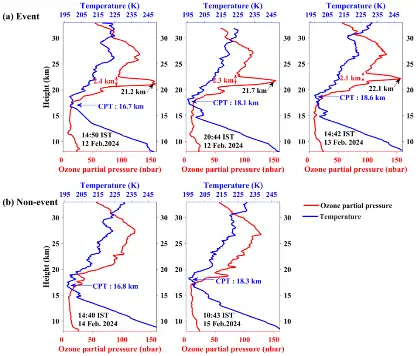
Figure 2. Height profiles of vertical air motion measured from different ST/MST radars during event days when the enhanced ozone is observed (12 & 13 February 2024), and during non-event days (14 February 2024) when normal ozone profiling is observed. Cold-point tropopause and O3 enhancement heights are marked on the event days.