EOS-06/Oceansat-3 detects impact of the developing El Niño on Marine Productivity in the
Equatorial Pacific Ocean
Home
/EOS-06/Oceansat-3 detects impact of the developing El Niño on Marine Productivity in
the Equatorial Pacific Ocean
September 10, 2026
The El Niño–Southern Oscillation (ENSO) is a major global climate phenomenon occurs in the tropical Pacific Ocean, characterised by alternating phases of anomalous warming (El Niño) and cooling (La Niña). These large-scale changes in the tropical Pacific can influence weather and climate patterns across the globe.
During El Niño, weakened equatorial trade winds and a deepening thermocline reduce the upward transport of cool, nutrient-rich waters from the subsurface. With fewer nutrients reaching the sunlit upper ocean, phytoplankton growth can be suppressed, resulting in lower concentrations of surface chlorophyll-a and, consequently, reduced marine productivity.
To better understand the evolution of ENSO during 2026, ISRO’s National Remote Sensing Centre (NRSC) analysed observations on Chlorophyll-a measurements from the Ocean Colour Monitor-3 (OCM-3) combined with ocean-surface wind vector observations from the EOS-06 Scatterometer across the tropical Pacific for April, May and June during 2023–2026.
A comparison of the June 2024 and June 2025 composites, representing neutral ENSO conditions, with June 2026 observations during the developing El Niño reveals a notable reduction in surface chlorophyll-a. This decline coincides with a reversal of ocean-surface winds—from easterlies, which blow from east to west, to westerlies, which blow from west to east. This weakening and reversal of the prevailing winds suppresses the normal equatorial upwelling across parts of the western and central equatorial Pacific. The resulting reduction in the supply of nutrient-rich subsurface waters is reflected in the observed decline in surface chlorophyll-a. The apparent contraction of the westward extent of the elevated-chlorophyll region between April and June 2026 further supports the weakening of equatorial upwelling as the El Niño event developed.
This synergistic application of multi-sensor data from both OCM-3 and Scatterometer sensors of EOS-06 conforms the strong biophysical coupling in the equatorial Pacific Ocean during the ongoing ElNino event. If this El Niño intensifies further as forecasted, the low-chlorophyll region may become more pronounced with time. This should be further inferred with concurrent estimates of anomalies in equatorial winds, sea-surface temperature, sea-level height, thermocline depth, and ocean circulation in the coming months.
The observations from EOS-06/Oceansat-3 also complement the World Meteorological Organization (WMO) outlook. In its June 2026 El Niño/La Niña update, the WMO estimated an approximately 80% probability of El Niño conditions developing during June–August 2026, with several forecast models indicating the possibility of a strong event. By late July, the WMO reported that El Niño conditions were intensifying and were expected to strengthen during August–October 2026. Satellite observations from EOS-06/Oceansat-3 reveal a clear decline in marine productivity associated with the developing El Niño conditions across the equatorial Pacific Ocean.
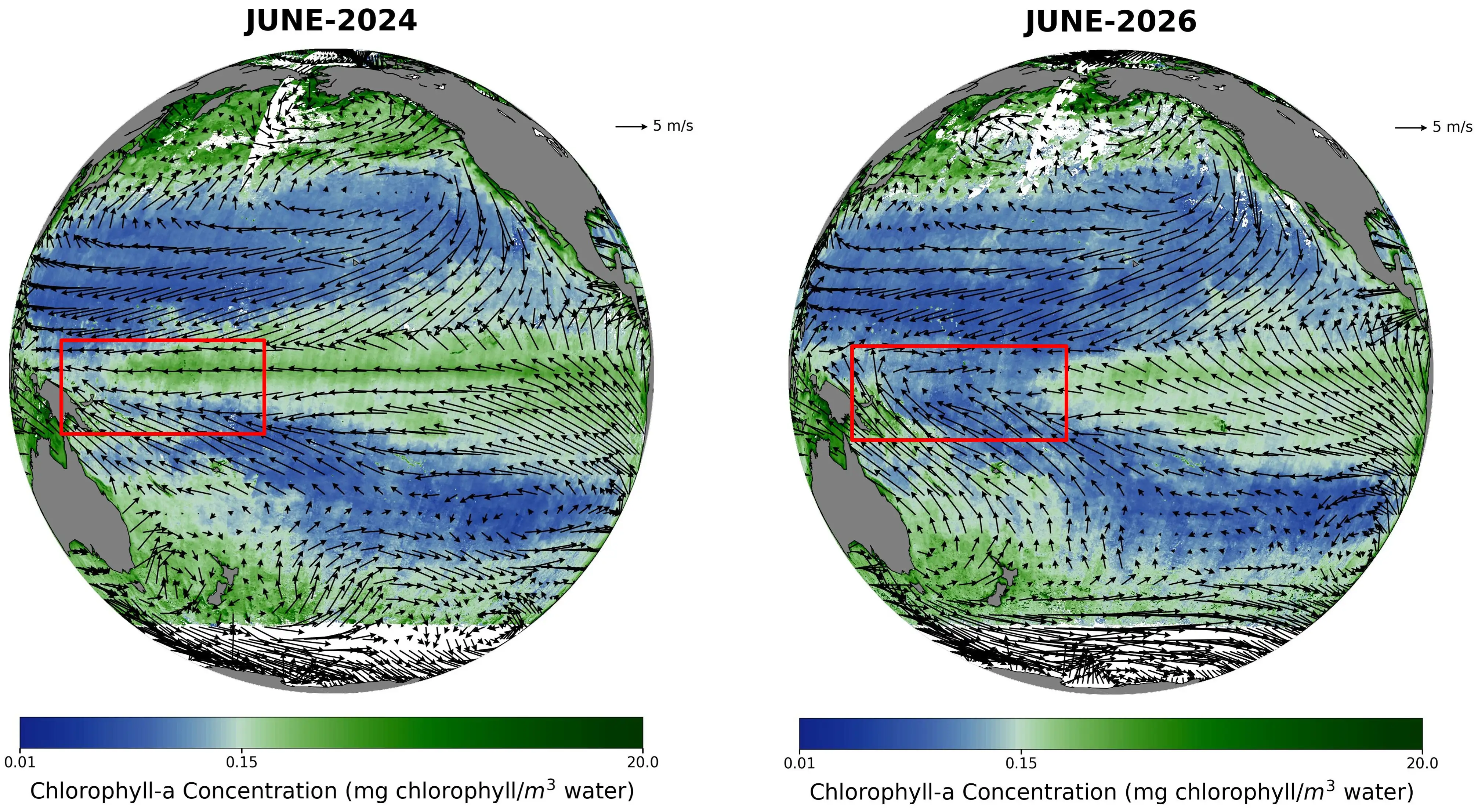
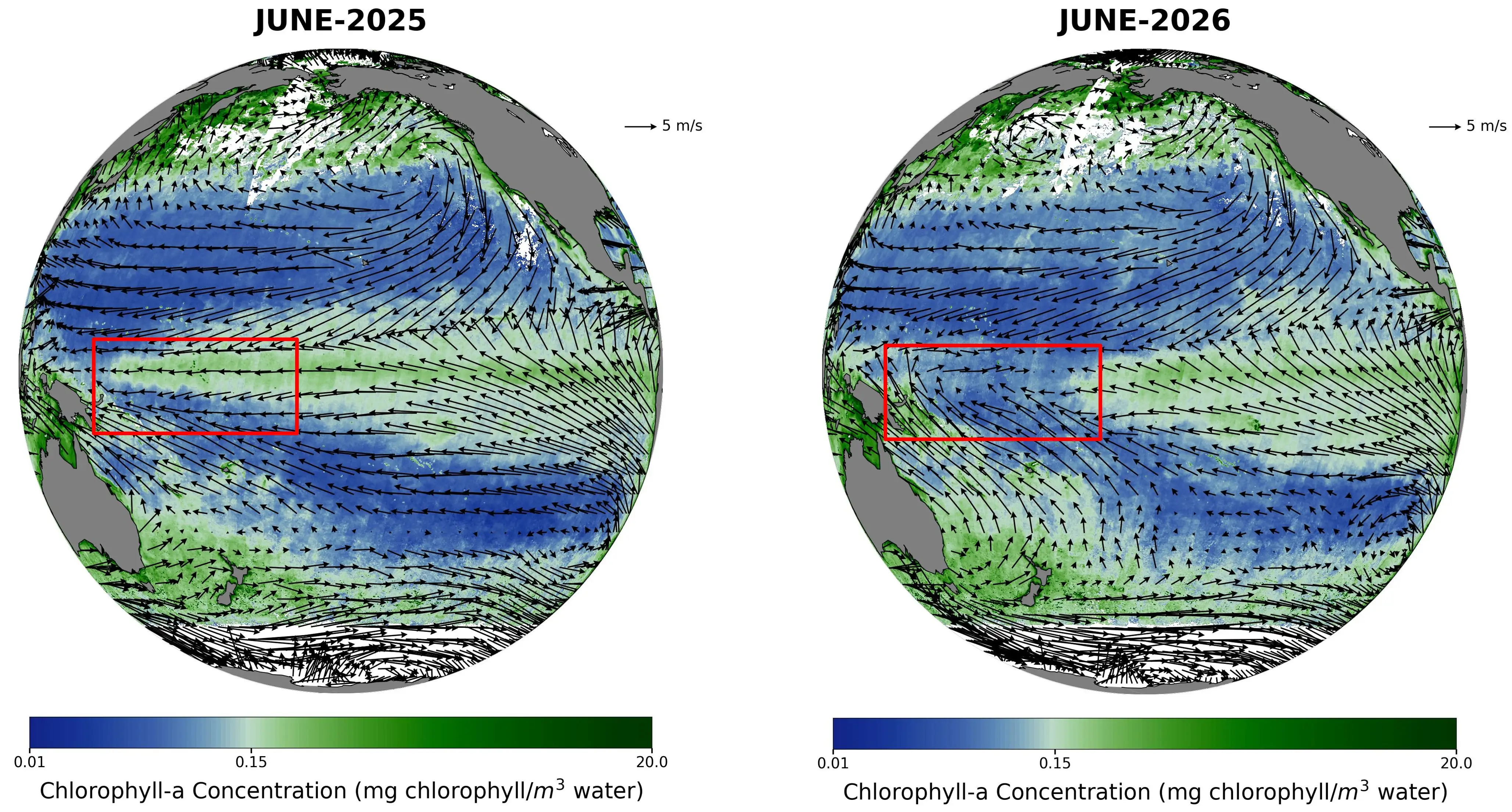
Figure Caption: Monthly mean Chl-a (mg/m3) and ocean surface wind vectors (m/s) derived from EOS-06/Oceansat-3 Ocean Colour Monitor (OCM-3) and Scatterometer data depicting the El Niño induced reduction in Chl-a and reversal/weakening of winds in the western Pacific Ocean in June 2026 compared with 2024 and 2025.