Chandrayaan-3's Alpha Particle X-ray Spectrometer measurements connect the composition
at Shiv Shakti Statio to the first Lunar Meteorite ALHA 81005
Home
/ Chandrayaan-3's Alpha Particle X-ray Spectrometer measurements connect the composition
at Shiv Shakti Statio to the first Lunar Meteorite ALHA 81005
July 03, 2026
After successful soft-landing of Chandrayaan-3 Lander on 23 August 2023, the Alpha Particle X-ray Spectrometer (APXS) onboard Pragyan rover measured the elemental composition at the Shiv Shakti Statio located at 69.37° S, 32.32° E in the southern high-latitudes on the nearside of the Moon.
In a new study, scientists from the Physical Research Laboratory (PRL), Ahmedabad, carried out a comprehensive geochemical analysis of the APXS measurements to reveal that the geochemical composition of the Shiv Shakti Statio closely resembles that of ALHA 81005,a meteorite discovered in the Allan Hills region of Antarctica during the 1981-1982 expedition. ALHA 81005 holds a special place among the Lunar meteorites because it was the first meteorite to be classified as having a lunar origin (Figure 1).
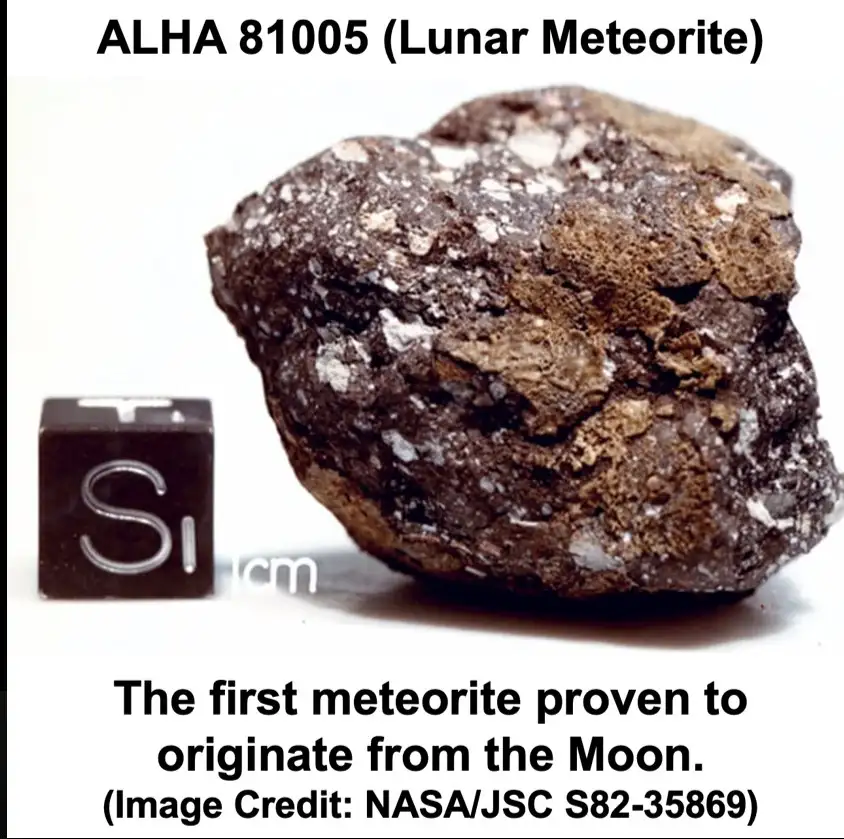
Figure 1:Picture of the Lunar meteorite ALHA 81005
The average composition of Shiv Shakti Statio is homogenous and the observations revealed that the soil contains lower aluminium abundance and higher Iron and Magnesium abundances, when compared to typical lunar highland regions (Table 1). In addition, the ratio between olivine/pyroxene at Shiv Shakti Statio is higher than typical Feldspathic Highland Terrain (FHT) on the Moon.
| Oxide | Unit | Mean abundance of Shiv Shakti | Mean abundance of FHT | Mean abundance of ALHA 81005 |
|---|---|---|---|---|
| Al2O3 | wt% | 26.1 | 29.6 | 25.8 |
| FeO+MgO | wt% | 14.4 | 8.15 | 13.7 |
| Mg# | mol% | 70 | 65.5 | 73 |
Table 1: Comparison between chemical composition of the Shiv Shakti Statio, feldspathic highland terrane (FHT) and lunar meteorite ALHA 81005.
Scientists compared the Chandrayaan-3 data with 66 lunar meteorites collected from different regions on Earth. Among all meteorites examined, ALHA 81005 emerged as the closest geochemical match to the Shiv Shakti Statio. In particular, both the meteorite and the Chandrayaan-3 landing site occupy a rare compositional space between two major lunar rock groups known as ferroan anorthosites (FAN) and Mg-suite rocks, further demonstrating their geochemical similarity. Additionally, both the meteorite and Shiv Shakti Statio contain nearly similar amounts of aluminium oxide (Al₂O₃) and a combination of iron oxide (FeO) and magnesium oxide (MgO)(Figure 2). These observations do not mean the Lunar meteorite came from the Shiv Shakti Statio; rather, it indicates that both represent a similar type of magnesium-rich lunar crust and regolith.
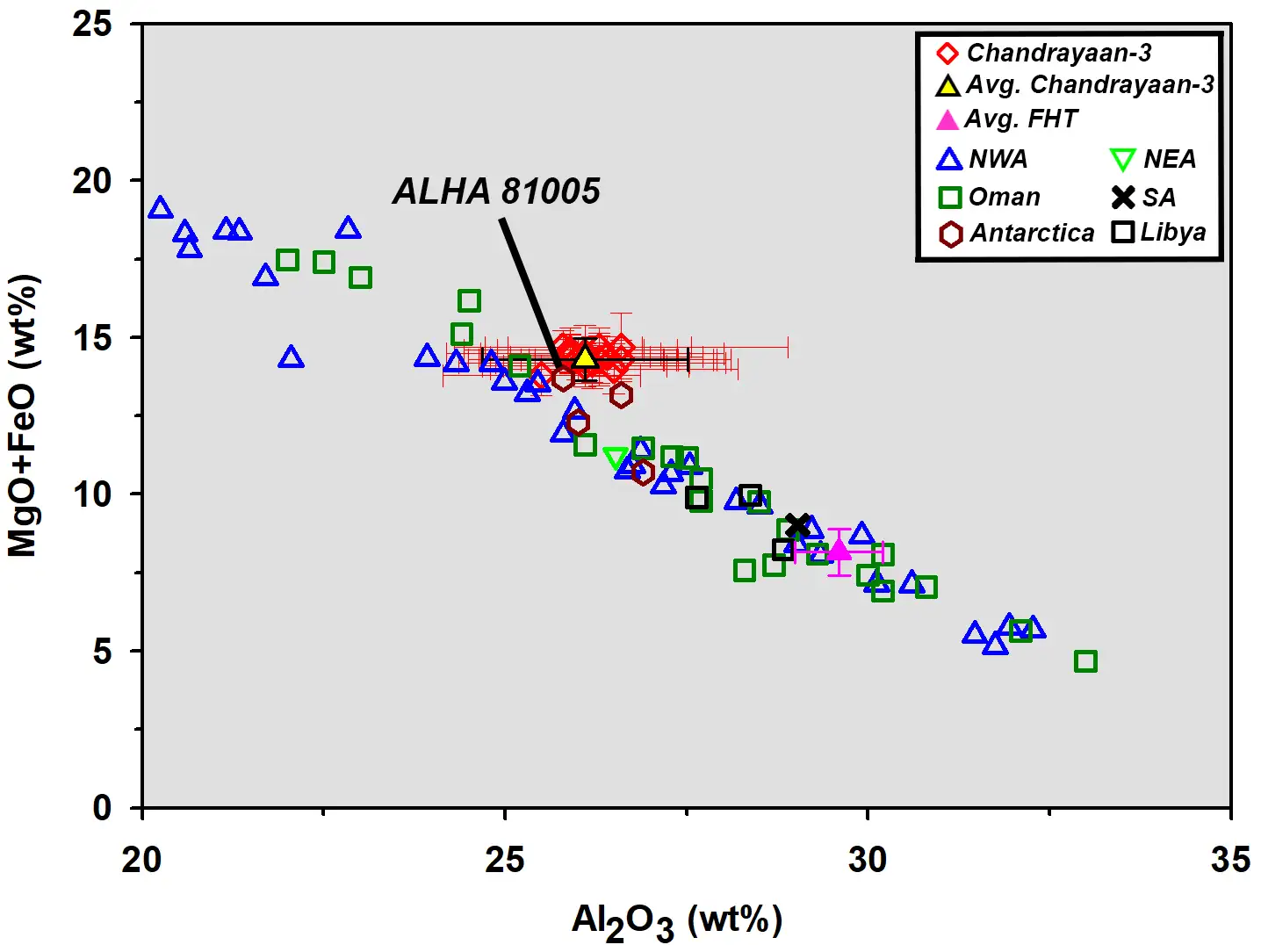
Figure 2: A comparison of concentrations of Al2O3 and MgO+FeO in Chandrayaan-3, lunar meteorites collected from different regions on Earth and FHT. Lunar meteorite ALHA 81005 shows the closest geochemical match with the Chandrayaan-3 APXS measurements. Plot symbols: FHT: Feldspathic Highland Terrane; NWA: Northwest Africa; NEA: Northeastern Africa; SA: Southern Africa.
Further geochemical analysis argues that the soil at Shiv Shakti Statio is a mixture of materials from different layers of the Moon's crust. The surface appears to contain not only material from the upper crust but also fragments of magnesium-rich rocks, likely derived from the Moon's deeper layers. Given the proximity of Shiv Shakti Statio to the South Pole-Aitken (SPA) basin (~350 km), it is possible that materials excavated from deeper layers during the SPA basin forming event were incorporated into the soils at the Chandrayaan-3 landing site.
These findings are consistent with earlier APXS studies that supported the Lunar Magma Ocean (LMO) hypothesis and revealed the presence of primitive mantle-related materials at the landing site.
In summary, this is one of the pioneering scientific studies to establish a direct correlation between the Chandrayaan-3 APXS measurements and lunar meteorite records. In summary, this is one of the pioneering scientific studies to directly connect the Chandrayaan-3 APXS measurements with lunar meteorite records. By linking the Shiv Shakti Statio to the Moon's first recognized meteorite, the Chandrayaan-3 mission has opened new avenues for understanding the formation of the ancient lunar crust.
Reference: “Chandrayaan-3 APXS
measurements reveal Lunar highland compositional diversity and meteorite
connections” authored by Dwijesh Ray, Rishitosh K. Sinha, Santosh V.
Vadawale, M. Shanmugam and Anil Bhardwaj, npj Space Exploration, vol. 2,
Article# 25, and is available at:
https://www.nature.com/articles/s44453-026-00041-0
https://doi.org/10.1038/s44453-026-00041-0