Atmospheric Re-entry of LVM3 M5 Upper Stage on 30 July 2026
Home
/Atmospheric Re-entry of LVM3 M5 Upper Stage on 30 July 2026
August 12, 2026
The upper stage (C25) of India’s Launch Vehicle Mark 3 (LVM3) which was launched on the 2nd November, 2025 from Sriharikota, re-entered the atmosphere on 30th July 2026. Marking the 5th operational flight of LVM3, it successfully injected the CMS-03 communication satellite into its intended Geostationary Transfer Orbit (GTO) with a perigee at 170 km and apogee at 29970 km. After spacecraft injection, the upper stage was passivated to limit any risks of accidental break-up, and left in a highly elliptical, 21 deg inclined GTO. It was routinely tracked by the US Space Command (USSPACECOM) as an object of NORAD id 66310 and International Designator 2025-249A. ISRO’s System for Safe and Sustainable Space Operations Management (IS4OM) kept a close watch on the orbital decay of LVM3-M5 rocket body and regularly predicted its atmospheric re-entry during its final orbital phase. The Multi Object Tracking Radar (MOTR) at Sriharikota was also engaged to track the object wherever feasible, till a few orbits before its re-entry.
The most probable impact time was estimated to be around 12:08 UTC, 30 July 2026, in the Atlantic Ocean, as shown in the figure below. Only a few elements like gas bottles, nozzle, and tanks, which are made of materials with very high melting points, were expected to survive the intense aerothermal heating during the re-entry.
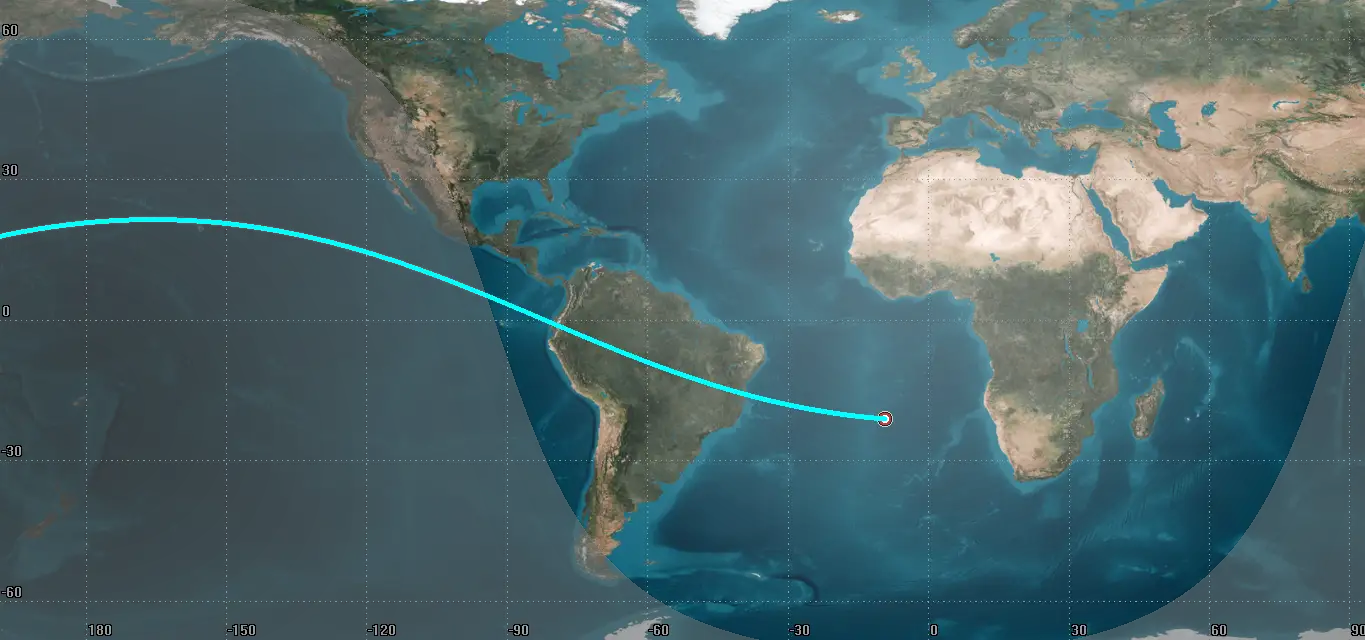
The final ground trace of LVM3-M5 upper stage
It is well known that for GTO missions, even a few minutes change in lift-off time can lead to a very large change in the orbital lifetime of the upper stage (from a few months to more than a few decades). Therefore, it has been a standard practice in ISRO to make additional considerations for the post-mission orbital lifetime of the upper stages while selecting lift-off timings for GTO mission. For LVM3 M5, the pre-launch orbital life time estimate of the C25 stage was less than a year corresponding to the liftoff at 17:26 IST (11:56 UTC), 2 Nov 2025. The actual residual orbital lifetime of the rocket body turned out to be within 9 months, close to the predicted lifetime, and is fully compliant with the IADC recommended 25-year rule applicable to the lifetime of objects ending their mission in Low Earth Orbit (LEO) region. It also meets the India’s Debris Free Space Mission (DFSM) requirement, which recommends a shorter orbital lifetime of 5 years for rocket stages which pass through the heavily crowded LEO region.
The short orbital lifetime of the LVM3 M5 upper stage could be achieved through proper planning, and is highly significant in the backdrop of growing population of space objects in LEO orbits.
(More details about DFSM are available here